Services
Services
Laboris nisi ut aliquip ex ea commodo consequat. Duis aute irure dolor in reprehenderit in voluptate velit esse cillum dolore eu fugiat nulla pariatur. Excepteur sint occaecat cupidatat.
- Lorem ipsum
- Dolor sit amet
- Consectetur
- Adipiscing elit
-
Reprehenderit in voluptate velit esse cillum dolore eu fugiat nulla pariatur. Excepteur sint occaecat cupidatat non proident, sunt in culpa qui officia deserunt mollit anim id est laborum.
- Lorem ipsum
- Dolor sit amet
- Consectetur
- Adipiscing elit
Image to follow: Combined analysis
Dolor in reprehenderit in voluptate velit esse cillum dolore eu fugiat nulla pariatur. Excepteur sint occaecat cupidatat non proident, sunt in culpa qui officia deserunt mollit anim id est laborum. Lorem ipsum dolor sit amet, consectetur adipiscing elit, sed do eiusmod tempor incididunt ut labore et dolore magna aliqua. Ut enim ad minim veniam, quis.
Nulla pariatur. Excepteur sint occaecat cupidatat non proident, sunt in culpa qui officia deserunt mollit anim id est laborum. Lorem ipsum dolor sit amet, consectetur adipiscing elit, sed do eiusmod tempor incididunt ut labore et.
Amet, consectetur adipiscing elit
In voluptate velit esse cillum dolore eu fugiat nulla pariatur. Excepteur sint occaecat cupidatat non proident, sunt in culpa qui officia deserunt mollit anim id est laborum. Lorem ipsum dolor sit amet, consectetur adipiscing elit, sed do eiusmod tempor incididunt ut labore et dolore magna aliqua. Ut enim ad minim veniam, quis nostrud exercitation ullamco laboris nisi ut aliquip ex.
Tempor incididunt ut labore
- Dolor in reprehenderit in voluptate velit.
- Velit esse cillum dolore eu fugiat nulla.
- Fugiat nulla pariatur. Excepteur sint occaecat cupidatat non.
- Occaecat cupidatat non proident, sunt in culpa qui officia.
- In culpa qui officia deserunt mollit anim id est laborum.
Aliqua. Ut enim ad
Eu fugiat nulla pariatur. Excepteur sint occaecat cupidatat non proident, sunt in culpa qui officia deserunt mollit anim id est laborum. Lorem ipsum dolor sit amet, consectetur adipiscing elit, sed do eiusmod tempor incididunt ut labore et dolore magna aliqua. Ut enim ad minim veniam.
-
Determine element contents and investigate material differences – for raw material testing, production control and industrial quality assurance. Terrachem analyses solid, powdered, liquid and pasty materials by X-ray fluorescence analysis (XRF). We tailor the scope of analysis, preparation and evaluation to your sample and testing task.
- Preparation adapted to the material
- Traceable measured values
- Dedicated contact person
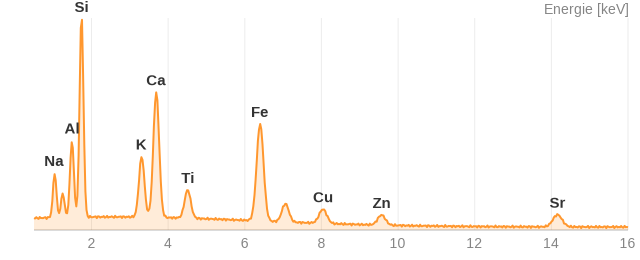
Sample: container glass, fused bead · Illustration – not measurement data Typical testing tasks
Testing raw materials and delivery batches
Does the chemical composition meet your expectations? We determine relevant element contents and compare supplier, incoming goods and reference samples.
Monitoring production and material fluctuations
We analyse production batches, intermediate products and conspicuous materials. The results help you detect chemical differences and plan further investigation steps. For recurring samples, we agree a testing programme with consistent preparation and presentation of results.
Obtaining measured values for your assessment
Do you need element contents for customer specifications or regulatory questions? We agree parameters, measuring ranges and required limits of quantification with you. We do not carry out a subsequent conformity assessment.
Our analytical services
Among other things, we analyse glass, ceramics, mineral raw materials, rocks, metallic materials and secondary raw materials. Suitable liquids and pastes can also be analysed.
Our services include:
- Qualitative analyses for orientation
- Quantitative determination of selected element contents
- Analysis of major, minor and trace components within the suitable measuring range
- Preparation adapted to the material and comparison of several samples
- Documentation of the agreed results in the test report
Which elements and concentrations can be determined depends on the material, preparation and available calibration.
For electrical and electronic products, we also offer XRF screening for lead, mercury, cadmium, total chromium and total bromine. It provides element information but does not replace a full proof of RoHS conformity.
Sample preparation to suit the material
For mineral and powdered materials, pressed pellets or fused beads are options, for example. Metallic samples may require suitable surface preparation. Liquid and pasty materials need preparation and a measuring set-up adapted to their properties.
Please only clean, dry or grind your sample after consulting us.
When element contents alone are not enough
A standard XRF element analysis does not automatically show in which compounds or crystalline phases the elements are present. Results calculated and reported as oxides are not in themselves proof of specific compounds or oxidation states. For additional phase information, XRD can be useful. We offer the targeted differentiation of certain silicon-containing constituents with a separate in-house method.
Process and sample shipment
The standard turnaround time is usually 5–10 working days. For urgent orders, express processing within 72, 48 or 24 hours is available by prior arrangement. We confirm the available time frame for your specific scope of analysis.
Accreditation and personal support
Our accreditation to DIN EN ISO/IEC 17025 covers the quantitative determination of selected elements in oxides, glasses, ashes and oils, and the semi-quantitative determination of selected elements in solids by wavelength-dispersive X-ray fluorescence analysis.
Whether your specific analysis falls within the current scope of accreditation, we clarify on the basis of material, test method and parameters before you place the order.
You get a dedicated contact person who coordinates any complementary analyses and brings the results together into one technical picture.
Frequently asked questions about XRF analysis
Which elements can be determined?
That depends on your sample and the information you need. Send us the relevant elements, expected concentrations and any required limits of quantification. We will check the suitable scope of analysis.
Can XRF detect specific chemical compounds?
A standard element analysis does not clearly distinguish chemical compounds. For example, a total chromium content does not describe the proportion of hexavalent chromium. Such questions require suitable additional methods.
Is the sample altered during the analysis?
That depends on the preparation. Grinding or fusion alters the sample. If it has to be preserved, we clarify in advance whether a suitable analysis without this preparation is possible.
You will find more information in our central FAQ.
Request a quotation for your element analysis
Send us a description of the material, the number of samples and the parameters you need. Existing specifications and earlier results help us plan.
Phone: +49 621 876797-0
E-mail: info@terrachem.de -
X-ray diffraction analysis (XRD) allows an exact determination of the crystalline structure of substances. This makes it possible to identify the solids contained in the sample unambiguously. The measurement results are correlated with an international database covering several thousand substances.
- Lorem ipsum
- Dolor sit amet
- Consectetur
- Adipiscing elit
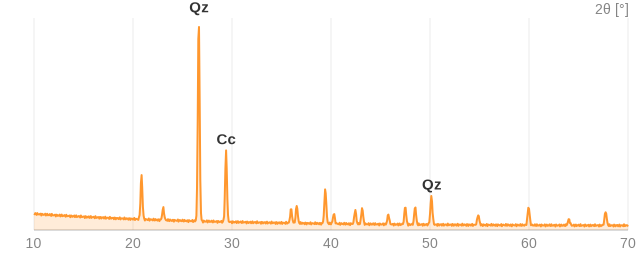
Sample: silica sand with calcite · Illustration – not measurement data X-ray diffraction at Terrachem GmbH
Our analytical laboratory has many years of experience and a competent analysis team in X-ray diffraction.
Principle of X-ray diffraction
The principle of X-ray diffraction is described by Bragg’s law. A parallel incident beam (red) is reflected by the lattice planes of a crystal structure. The lower beam travels a longer distance. This phase difference (yellow) is called the path difference (t). If the path difference equals a multiple of the X-ray wavelength (l), constructive interference produces an X-ray reflection. In X-ray diffraction analysis, every compound produces a series of reflections typical of its atomic structure, which can then be assigned to a specific substance.
Sample materials for X-ray diffraction
As specialists in X-ray analysis, our clients value our know-how in areas including:
- Medical technology products (e.g. dental ceramics, implants)
- Refractory materials (metallic silicon, silicon carbide, corundum, zircon, etc.)
- Clay and glass-ceramic products (e.g. kaolins and silicate glass raw materials)
- Electrochemical sensors
- Inorganic filter and pigment materials
- Cement raw materials (carbonates, sulphates, etc.)
- Building and insulation materials
- Natural rock and stones (granite, marble, sandstone, slate, etc.)
- Industrial minerals (salts, ores, zeolites, quartz, diamond, etc.)
-
Tempor incididunt ut labore et dolore magna aliqua. Ut enim ad minim veniam, quis nostrud exercitation ullamco laboris nisi ut aliquip ex ea commodo consequat. Duis aute irure.
- Lorem ipsum
- Dolor sit amet
- Consectetur
- Adipiscing elit
Image to follow: SEM
Do eiusmod tempor incididunt ut labore et dolore magna aliqua. Ut enim ad minim veniam, quis nostrud exercitation ullamco laboris nisi ut aliquip ex ea commodo consequat. Duis aute irure dolor in reprehenderit in voluptate velit esse cillum dolore eu fugiat nulla pariatur. Excepteur sint occaecat cupidatat non proident, sunt in culpa qui officia deserunt.
Enim ad minim veniam, quis nostrud exercitation ullamco laboris nisi ut aliquip ex ea commodo consequat. Duis aute irure dolor in reprehenderit in voluptate velit esse cillum dolore eu fugiat nulla pariatur. Excepteur sint occaecat.
Ipsum dolor sit amet
Incididunt ut labore et dolore magna aliqua. Ut enim ad minim veniam, quis nostrud exercitation ullamco laboris nisi ut aliquip ex ea commodo consequat. Duis aute irure dolor in reprehenderit in voluptate velit esse cillum dolore eu fugiat nulla pariatur. Excepteur sint occaecat cupidatat non proident, sunt in culpa qui officia deserunt mollit anim id est laborum. Lorem ipsum dolor.
Sed do eiusmod tempor
- Do eiusmod tempor incididunt ut labore.
- Labore et dolore magna aliqua. Ut enim.
- Ut enim ad minim veniam, quis nostrud exercitation.
- Quis nostrud exercitation ullamco laboris nisi ut aliquip ex.
- Nisi ut aliquip ex ea commodo consequat. Duis aute irure.
Et dolore magna aliqua
Aliqua. Ut enim ad minim veniam, quis nostrud exercitation ullamco laboris nisi ut aliquip ex ea commodo consequat. Duis aute irure dolor in reprehenderit in voluptate velit esse cillum dolore eu fugiat nulla pariatur. Excepteur sint occaecat cupidatat non proident, sunt in culpa qui officia.
-
TGA measures the change in mass of a sample as a function of temperature and time.
- Lorem ipsum
- Dolor sit amet
- Consectetur
- Adipiscing elit
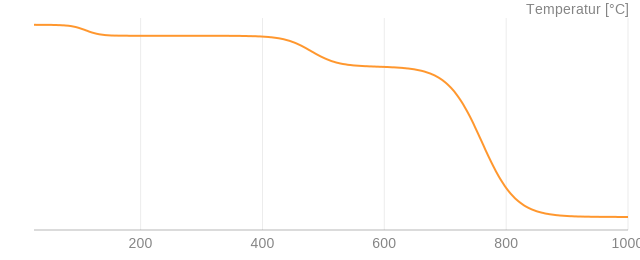
Sample: limestone · Illustration – not measurement data Depending on the question, samples can be heated under oxidising conditions (air or oxygen) or under a nitrogen atmosphere to avoid oxidation. Changes in mass can have the following causes:
- physical processes (e.g. vaporization, sublimation)
- decomposition (with formation of volatile products)
- or chemical reactions (oxidation and reduction)
The resulting change in weight (loss or gain), together with the temperature at which it occurs, allows conclusions about the composition of the sample. Typical applications of thermogravimetry include the determination of:
- moisture or water content
- proportion of volatile compounds (e.g. oil residues, fillers or plasticisers in plastics)
- carbonate content and loss on ignition
- inorganic fillers (e.g. chalk, glass fibres, carbon black)
Principle of thermogravimetric analysis
In coal analysis, for example, the change in mass can be used to determine quantitatively the moisture, the proportion of volatiles, the fixed carbon and the ash content of coals.
To determine the analytical moisture, the sample is heated in a crucible made of temperature-stable, inert material (platinum or Al2O3) under a nitrogen atmosphere to 110 °C and held at this temperature for 1 minute. The resulting loss of mass corresponds to the moisture content of the sample. It is then heated dynamically to a final temperature of 900 °C. Switching the atmosphere gas to oxygen then oxidises the carbon content and all other oxidisable components. The ash remains as residue. The change in mass during combustion is attributed to the fixed carbon. In combination with X-ray fluorescence analysis (XRF), it is also possible to determine, for example, the proportion of metallic iron, which reacts with oxygen at high temperatures and leads to an increase in weight.
Relevant standards for TGA
DIN 51006:2005-07 – Thermal analysis (TA) – Thermogravimetry (TG) – Principles DIN EN 12485:2010-08 – Chemicals used for treatment of water intended for human consumption – Calcium carbonate, high-calcium lime, half-burnt dolomite, magnesium oxide and calcium magnesium carbonate – Test methods
-
LiTrap is the name of a sample carrier that can absorb liquids. It can then be measured by X-ray fluorescence under vacuum, which makes it a tool for the material analysis of liquids. The LiTrap method was developed by the company’s founder, Dr. Rüttimann; the name comes from “liquid trap”.
- Lorem ipsum
- Dolor sit amet
- Consectetur
- Adipiscing elit
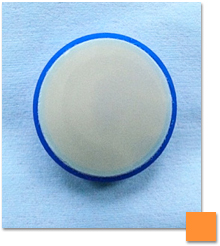
For sample preparation, the liquid sample material is applied to the LiTrap. LiTraps can also be used as a carrier for pasty samples. Depending on viscosity and polarity, the samples soak into the carrier more or less quickly and can then be measured under vacuum.
fast – reproducible – cost-effective
The idea is as simple as it is ingenious: a highly absorbent material is used as the sample holder. The liquid is applied to the carrier and, depending on its viscosity, soaks into it more or less quickly. The liquid is bound so strongly that it does not evaporate even under vacuum. Compared with the classic analysis under helium, there is no need to fill sample cups, and so no film in the X-ray path, which makes it impossible to detect the light elements. Without these interfering factors, the detection limits of the method are lower overall. Liquids can now be analysed under more favourable conditions. Another advantage of this method shows in the analysis of suspended particles in liquids. When a contaminated sample is applied, the liquid soaks into the carrier and the particles stay on the surface. This makes it possible to detect, for example, metal abrasion in oil or dust particles in fuel in the smallest quantities.
Material analysis of liquids under vacuum
You need to analyse a liquid sample, but your instrument only works under vacuum, or the required sensitivity (or the element you are looking for) can only be reached without a film? Then LiTraps could be the solution.
Advantages of the LiTrap method over the classic liquid measurement in a cup:
- No film in the X-ray path
- Vacuum measurement
- No helium needed
- Light elements measurable (carbon, fluorine, sodium, nitrogen)
- No leakage of the sample during measurement
- Inhomogeneities in the samples can be measured specifically, e.g.:
– particles in oil
– emulsions – suspended matter and liquidsApplications and limitations of the LiTrap method:
- Simple and good: oil, fuels and polar solvents
- Preparation limits for aqueous solutions and water
– requires particularly slow and even application
– can be optimised by dilution with solvents- Acids and bases similar to water
- LiTraps consist mainly of aluminium and oxygen – these elements cannot be detected in the trace range
- Only a qualitative overview analysis is possible (no semi-quantitative evaluation by the fundamental parameter method)
- Quantitative applications need a clearly defined calibration
-
Since our foundation in 1985, we have been not only a competent partner for material analysis by X-ray fluorescence, but also on hand with advice and support for any questions you may have. Our consulting services in X-ray fluorescence range from simple applications with the X-ray spectrometer to training courses that build up your staff’s expertise.
- Lorem ipsum
- Dolor sit amet
- Consectetur
- Adipiscing elit
Our promise for your consulting in X-ray fluorescence
As in all areas of science, it is very difficult to grasp the essentials quickly in the material analysis of substances by X-ray fluorescence without practical experience. Results are often misinterpreted or can only be interpreted correctly with a great deal of time. With our help, you quickly get to the essential information in your analyses. Besides time, your customers’ trust plays a key role. They expect reliable products with high quality standards, which are very hard to achieve without a mature quality management system. Checking the quality of the products’ raw materials deserves particular attention. Good advice and many years of experience are decisive here. Our many years of practical experience in chemical analysis, in particular X-ray fluorescence analytics (XRF), are the basis for well-founded, competent and comprehensive advice.
Just give us a call: +49 621 876797-0