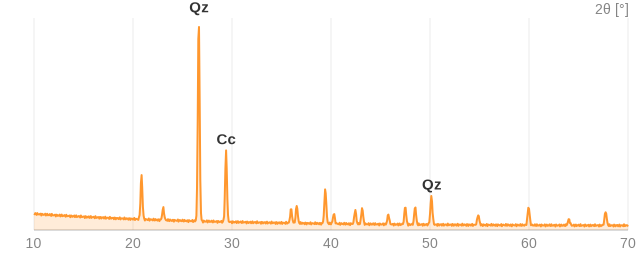
X-ray diffraction analysis (XRD) allows an exact determination of the crystalline structure of substances. This makes it possible to identify the solids contained in the sample unambiguously. The measurement results are correlated with an international database covering several thousand substances.
- Lorem ipsum
- Dolor sit amet
- Consectetur
- Adipiscing elit
X-ray diffraction at Terrachem GmbH
Our analytical laboratory has many years of experience and a competent analysis team in X-ray diffraction.
Principle of X-ray diffraction
The principle of X-ray diffraction is described by Bragg’s law. A parallel incident beam (red) is reflected by the lattice planes of a crystal structure. The lower beam travels a longer distance. This phase difference (yellow) is called the path difference (t). If the path difference equals a multiple of the X-ray wavelength (l), constructive interference produces an X-ray reflection. In X-ray diffraction analysis, every compound produces a series of reflections typical of its atomic structure, which can then be assigned to a specific substance.
Sample materials for X-ray diffraction
As specialists in X-ray analysis, our clients value our know-how in areas including:
- Medical technology products (e.g. dental ceramics, implants)
- Refractory materials (metallic silicon, silicon carbide, corundum, zircon, etc.)
- Clay and glass-ceramic products (e.g. kaolins and silicate glass raw materials)
- Electrochemical sensors
- Inorganic filter and pigment materials
- Cement raw materials (carbonates, sulphates, etc.)
- Building and insulation materials
- Natural rock and stones (granite, marble, sandstone, slate, etc.)
- Industrial minerals (salts, ores, zeolites, quartz, diamond, etc.)