LiTrap is the name of a sample carrier that can absorb liquids. It can then be measured by X-ray fluorescence under vacuum, which makes it a tool for the material analysis of liquids. The LiTrap method was developed by the company’s founder, Dr. Rüttimann; the name comes from “liquid trap”.
- Lorem ipsum
- Dolor sit amet
- Consectetur
- Adipiscing elit
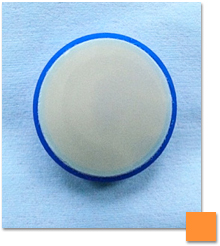
For sample preparation, the liquid sample material is applied to the LiTrap. LiTraps can also be used as a carrier for pasty samples. Depending on viscosity and polarity, the samples soak into the carrier more or less quickly and can then be measured under vacuum.
fast – reproducible – cost-effective
The idea is as simple as it is ingenious: a highly absorbent material is used as the sample holder. The liquid is applied to the carrier and, depending on its viscosity, soaks into it more or less quickly. The liquid is bound so strongly that it does not evaporate even under vacuum. Compared with the classic analysis under helium, there is no need to fill sample cups, and so no film in the X-ray path, which makes it impossible to detect the light elements. Without these interfering factors, the detection limits of the method are lower overall. Liquids can now be analysed under more favourable conditions. Another advantage of this method shows in the analysis of suspended particles in liquids. When a contaminated sample is applied, the liquid soaks into the carrier and the particles stay on the surface. This makes it possible to detect, for example, metal abrasion in oil or dust particles in fuel in the smallest quantities.
Material analysis of liquids under vacuum
You need to analyse a liquid sample, but your instrument only works under vacuum, or the required sensitivity (or the element you are looking for) can only be reached without a film? Then LiTraps could be the solution.
Advantages of the LiTrap method over the classic liquid measurement in a cup:
- No film in the X-ray path
- Vacuum measurement
- No helium needed
- Light elements measurable (carbon, fluorine, sodium, nitrogen)
- No leakage of the sample during measurement
- Inhomogeneities in the samples can be measured specifically, e.g.:
– particles in oil
– emulsions – suspended matter and liquids
Applications and limitations of the LiTrap method:
- Simple and good: oil, fuels and polar solvents
- Preparation limits for aqueous solutions and water
– requires particularly slow and even application
– can be optimised by dilution with solvents
- Acids and bases similar to water
- LiTraps consist mainly of aluminium and oxygen – these elements cannot be detected in the trace range
- Only a qualitative overview analysis is possible (no semi-quantitative evaluation by the fundamental parameter method)
- Quantitative applications need a clearly defined calibration