TGA measures the change in mass of a sample as a function of temperature and time.
- Lorem ipsum
- Dolor sit amet
- Consectetur
- Adipiscing elit
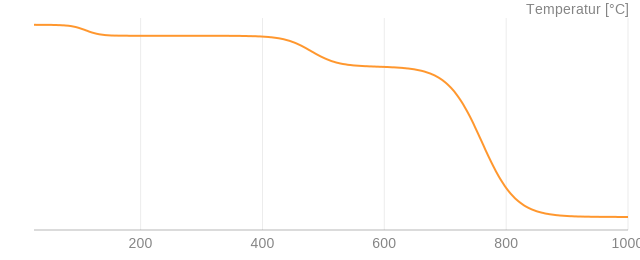
Depending on the question, samples can be heated under oxidising conditions (air or oxygen) or under a nitrogen atmosphere to avoid oxidation. Changes in mass can have the following causes:
- physical processes (e.g. vaporization, sublimation)
- decomposition (with formation of volatile products)
- or chemical reactions (oxidation and reduction)
The resulting change in weight (loss or gain), together with the temperature at which it occurs, allows conclusions about the composition of the sample. Typical applications of thermogravimetry include the determination of:
- moisture or water content
- proportion of volatile compounds (e.g. oil residues, fillers or plasticisers in plastics)
- carbonate content and loss on ignition
- inorganic fillers (e.g. chalk, glass fibres, carbon black)
Principle of thermogravimetric analysis
In coal analysis, for example, the change in mass can be used to determine quantitatively the moisture, the proportion of volatiles, the fixed carbon and the ash content of coals.
To determine the analytical moisture, the sample is heated in a crucible made of temperature-stable, inert material (platinum or Al2O3) under a nitrogen atmosphere to 110 °C and held at this temperature for 1 minute. The resulting loss of mass corresponds to the moisture content of the sample. It is then heated dynamically to a final temperature of 900 °C. Switching the atmosphere gas to oxygen then oxidises the carbon content and all other oxidisable components. The ash remains as residue. The change in mass during combustion is attributed to the fixed carbon. In combination with X-ray fluorescence analysis (XRF), it is also possible to determine, for example, the proportion of metallic iron, which reacts with oxygen at high temperatures and leads to an increase in weight.
Relevant standards for TGA
DIN 51006:2005-07 – Thermal analysis (TA) – Thermogravimetry (TG) – Principles DIN EN 12485:2010-08 – Chemicals used for treatment of water intended for human consumption – Calcium carbonate, high-calcium lime, half-burnt dolomite, magnesium oxide and calcium magnesium carbonate – Test methods